1. Introduction: The Brain Without Hands
You have access to models like Claude and GPT-4. They pass the bar exam and solve hard coding problems in seconds. Try asking that same system to do a basic office task. Tell it to check your Gmail, find your manager’s meeting notes, and update a Jira ticket. The answer is a flat no.
Today’s artificial intelligence has a major flaw. These models lack digital agency. They think and reason well. They just cannot interact with the tools people use every day. An AI cannot block off thirty minutes on your Google Calendar, run a SQL query on a production database, or send a direct message to your team on Slack. Artificial intelligence must connect its reasoning capabilities directly to system access to actually complete tasks.
2. Knowledge and Action are Two Different Worlds
The initial excitement for generative AI hit a massive deployment wall in 2023. Many companies thought buying a large language model would automatically run their workflows. The reality check came fast. An employee would ask about yesterday’s production issue. The AI would invent an answer because it lacked access to internal monitoring tools.
Knowing how to do something and actually doing it are entirely separate things. An AI can type out the exact steps for writing a professional email. It cannot open your email client and hit send unless someone builds a specific, hard-coded integration for it. Think of the difference between a consultant giving advice and an employee doing the actual work.
3. MCP is the USB-C for the AI Ecosystem
Connecting an AI to a business tool usually means entering integration hell. Developers historically had to write custom code for every single endpoint. Making a connection required building separate authentication flows, error handling protocols, and maintenance schedules for Gmail, Slack, GitHub, and SQL databases. A company using 50 tools creates 50 potential points of failure.
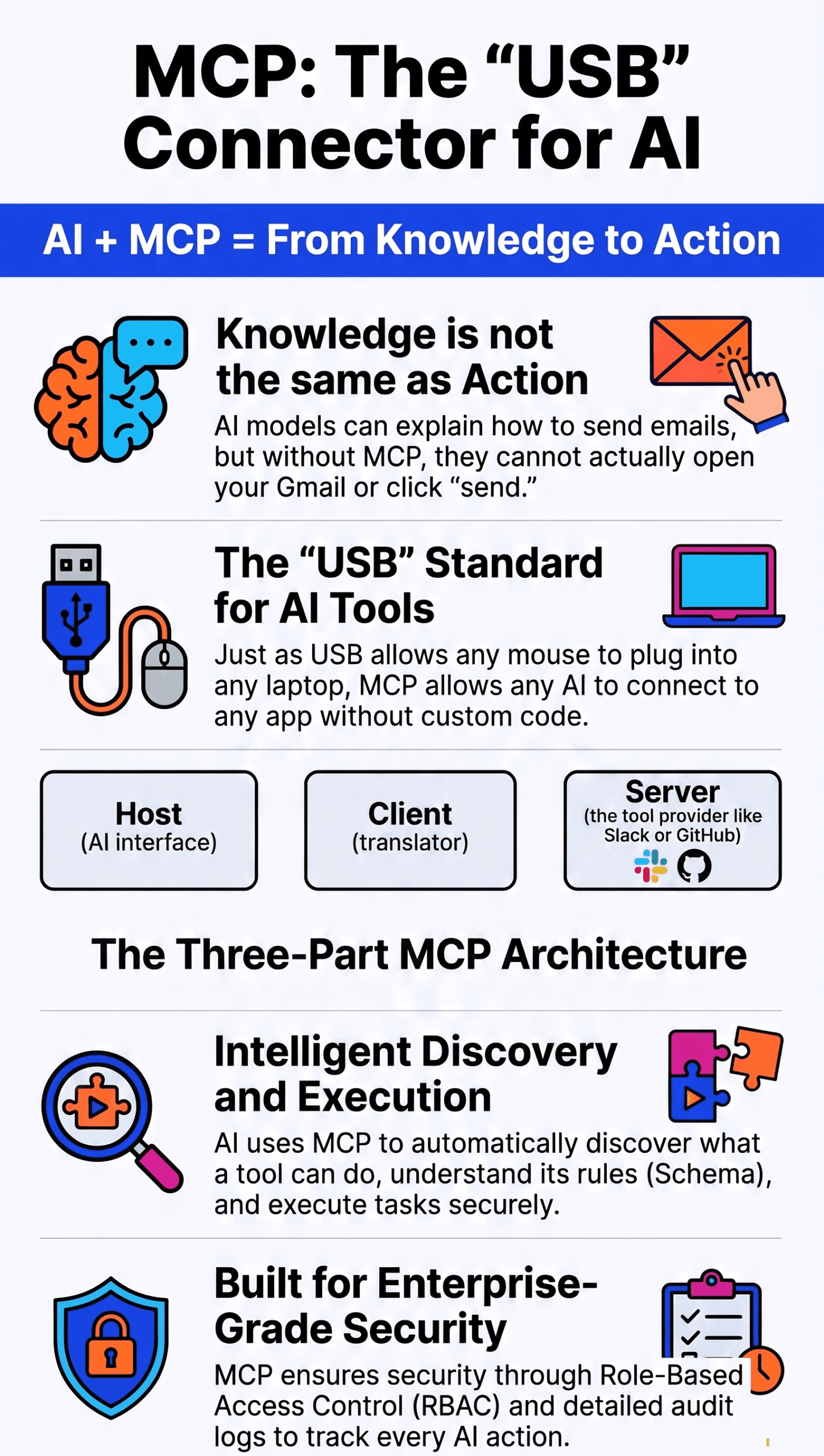
The Model Context Protocol fixes this problem by creating a universal communication layer. It works much like how HTTP standardized the web or SMTP standardized email. You can think of MCP as the USB-C for artificial intelligence software. Before USB-C became the standard, people dealt with a mess of proprietary chargers and ports. MCP does the same thing for software. It allows any host model to talk to any data source or tool through a single standardized port. You build one MCP server instead of 50 custom integrations. Any compliant AI can instantly understand that single server.
4. Runtime Discovery Replaces Hard-Coding
This protocol moves systems away from hard-coded knowledge. In traditional setups, an AI breaks if an API changes because its instructions are static. MCP introduces a host, client, and server architecture that enables runtime discovery.
The host is the AI interface. The client acts as the translator maintaining the connection. The server exposes specific tools and resources. Under this system, the AI never needs pre-training on your specific database. When a user asks a question, the model performs a request to discover available tools. It then reads a self-describing usage contract called a schema. A Gmail MCP server might tell the AI that searching emails requires a sender as a string and an unread status as a boolean. The system is entirely self-describing. The AI learns how to use the tool at the exact moment of execution by reading these requirements. It identifies the required parameters and completes the task dynamically. A human never has to write a single line of documentation for the AI to read.
5. Security as the Enterprise Gatekeeper
Convenience never outranks security in a corporate environment. An AI with the power to access a database must have strict guardrails. MCP handles this through an identity-first approach.
Treat the system like an ATM. The machine has the physical capability to dispense cash. It does nothing until you provide a PIN to verify your identity. MCP uses similar logic through OAuth and identity verification. A junior employee might ask about the CEO’s salary. The MCP server checks the role-based access control rules first. The request gets rejected before the AI ever sees the data if the user lacks proper permissions.
The protocol also provides a complete audit log for AI actions. Every interaction is traceable. The logs show which tool was used, what data was accessed, and who initiated the prompt. The system also enables graceful failure. If a Slack server goes down while a Jira server remains active, the AI will not crash entirely. It will report that it successfully updated the Jira ticket but could not notify the team on Slack due to the outage.
6. The Three Pillars of Modern AI Infrastructure
Moving toward autonomous agents requires us to stop looking at the language model in isolation. A functional enterprise system rests on three distinct pillars.
The language model acts as the brain. It handles the reasoning and understands the user’s intent. Retrieval-augmented generation acts as the memory. This allows the AI to read your internal documents and manuals. MCP provides the digital hands. It gives the AI the ability to reach out and touch your databases and software. These three components working in harmony turn a basic chatbot into a functional colleague. The language model reasons through the plan. The memory provides the necessary facts. The protocol executes the actual work across your tech stack.
7. Conclusion: From Answering Questions to Doing the Work
The shift from isolated intelligence to integrated agency alters how we build software. We are moving away from asking computers how to do our jobs. The AI will perform the actual work alongside human employees.
Picture a workflow where your computer does not just tell you about unread emails from your manager. It identifies the urgent action items, queries the database for the requested data, drafts a response, attaches the relevant report, and logs the entire interaction in your customer relationship management software. All of this happens through a single secure and standardized protocol. The infrastructure for this future is being built right now. Think about how your daily operations would change if your software could actively operate the exact same tools your team uses every single day.
Pingback: Your Next DevOps Teammate Doesn't Sleep: 4 Surprising Ways AI is Reimagining Cloud Operations - WordWyzz